


Discover
Key driver analysis
Which factors are most strongly associated with an outcome? Rank drivers with target-appropriate models, then inspect the evidence before it becomes a recommendation.
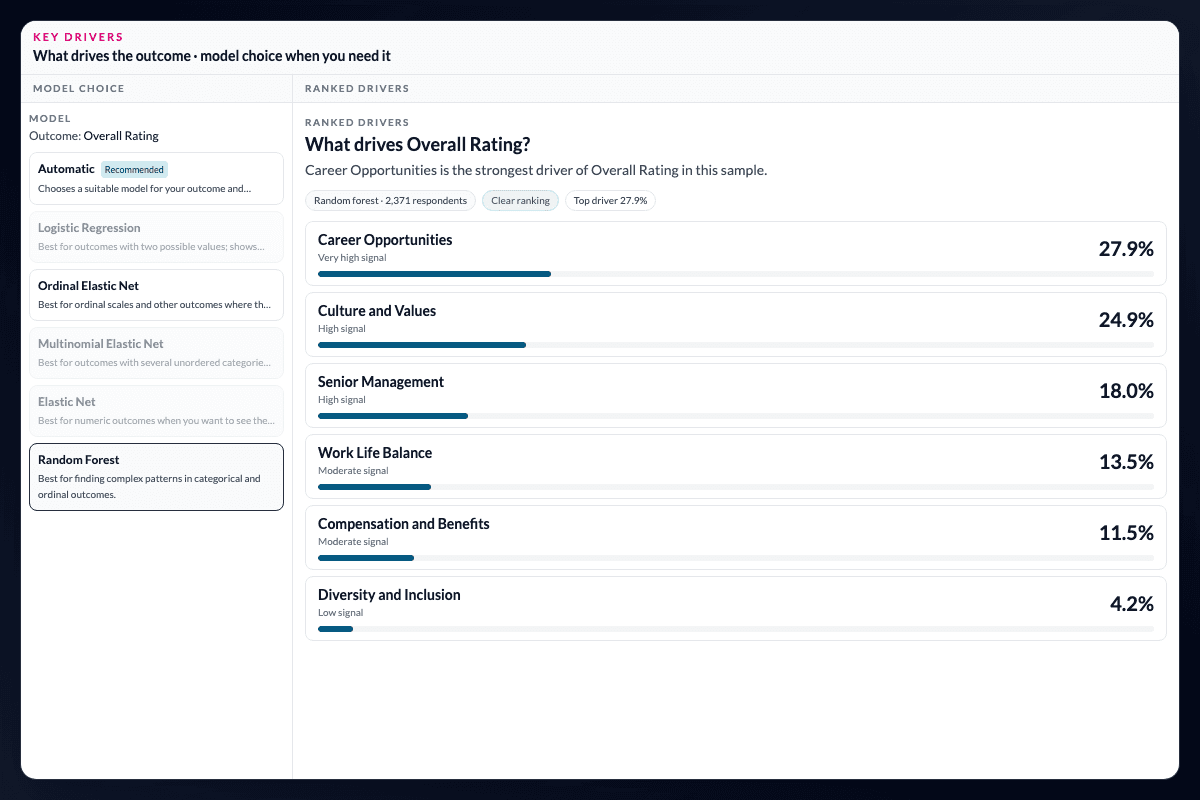
What is actually associated with the outcome you care about?
Pick an outcome, review candidate drivers, and run a target-appropriate model on mixed survey data: numbers, opinion scales, single categories, and multi-select columns together. AddMaple ranks drivers automatically without collapsing the result into a single black-box score.
Rank the strongest relationships.
Random Forest handles non-linear mixed data. Elastic Net supports numeric outcomes, logistic Elastic Net binary outcomes, and ordinal and multinomial Elastic Net ordered and multiclass outcomes; automatic routing is available when the engine should choose. Elastic Net models return interpretable coefficients with direction and magnitude.
Check when a ranking hides an important difference.
Signed, class-specific associations provide coefficient and sign information when one global ranking would mislead on Likert or multiclass outcomes. AddMaple also surfaces statistically related columns first in the driver picker, so the candidate list starts with plausible drivers rather than the full codebook.
Use a driver result as evidence, not a verdict.
Inspect ranked importance, model fit (out-of-bag accuracy or R²), and AI-generated interpretation, then save the result to Insights or dashboards. Key-driver analysis answers which factors matter most; use regression, PCA & multivariate modelling when you need explicit coefficients or latent dimensions.
Make the model useful to the person who has to explain it.
The output is not just a ranked list. Analysts can see which variables were considered, how the target shaped the method, whether the model fit is useful, and where direction is available. That creates a better bridge from statistical output to the stakeholder question: which parts of this experience should we investigate or act on next?
Questions teams ask
What question does key-driver analysis answer?
Key-driver analysis ranks which factors matter most for a chosen outcome, using target-appropriate models on mixed survey data.
Which models does AddMaple use for key drivers?
AddMaple supports Random Forest and regularised models including Elastic Net, logistic Elastic Net, ordinal Elastic Net, and multinomial Elastic Net, with routing based on the target.
How is key-driver analysis different from regression?
Key-driver analysis focuses on predictive importance and directional evidence across candidate factors, while regression estimates a focused relationship between named predictors and an outcome.
Read the evidence in context
Results depend on the study design, data quality, bases, weighting, and method settings. AddMaple calculates the statistical outputs; researchers review practical importance and interpretation. An association is not evidence of causation.
How it works
Step-by-step guides in the AddMaple help center.
- Key Driver Analysis
Rank which factors most influence an outcome — Random Forest for predictive importance on categorical outcomes, Elastic Net for directional evidence on numeric and binary targets.
- Related columns
Discover statistically associated columns before running a multivariate driver model.
- Regression
Model a focused outcome with explicit control variables when you need coefficient estimates beyond a driver ranking.
Part of AddMaple's feature areas
This capability sits within broader product areas on the features hub.
- Key drivers, regression & relationships
Continue exploring
Follow the next step in the workflow or explore a related capability.
- Regression, PCA & multivariate modellingWhat is the estimated relationship — and what structure sits behind the batteries? Linear and logistic regression with fitted charts, Elastic Net multivariate key-driver models, and PCA with optional Varimax rotation.
- Relationship discoveryPick any column and AddMaple automatically runs the right statistical test against every other variable — chi-square, ANOVA, t-tests, Kruskal-Wallis, Pearson and Spearman correlation — ranking thousands of pairwise results by significance and effect size.
See this capability on a real research workflow.
Bring one study or delivery workflow and we’ll show where AddMaple fits.