


Discover
Mental Availability & CEP analysis
Understand which brands come to mind across buying situations, compare mental availability and Category Entry Point associations, and compare CEP strengths and weaknesses.
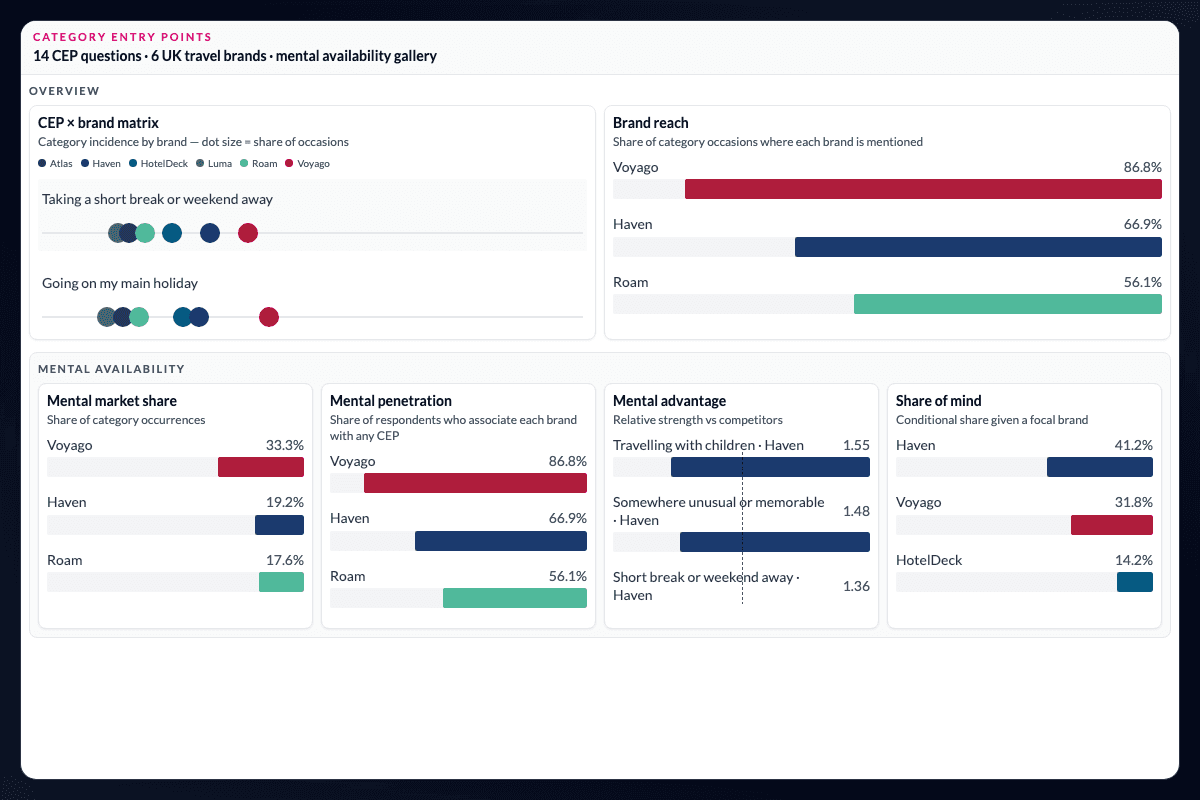
Which brands come to mind in which buying situations?
Purpose-built analysis for mental availability and Category Entry Point (CEP) research examines brand associations across buying situations—not a rebranded crosstab.
Read the strength of each brand–situation association.
- Mental penetration / brand reach — respondents associating a brand with at least one CEP, deduplicated across CEPs.
- CEP × brand matrix — category incidence across entry-point questions and competitive comparisons.
- Mental market share, network size, mental advantage, and share of mind — complementary views of association strength and breadth.
Keep the brand story connected to the research.
Group multiselect CEP columns as a Category entry points family, then open Analyze… → Mental availability. The resulting evidence stays in the project with banners, segmentation, wave comparisons, and Story Dashboards instead of being rebuilt in Excel or a separate specialist tool.
Make the metric answer a brand question.
Mental availability is not only a set of percentages. The useful question is where a brand is mentally available, where competitors are stronger, and which buying situations represent opportunity. Keeping the CEP structure and the resulting measures together lets researchers move between the category-level picture, a focal brand, and the cuts that matter to the decision.
Questions teams ask
What does Mental Availability and CEP analysis measure?
It measures brand associations across Category Entry Points, including mental penetration, brand reach, mental market share, network size, mental advantage, and share of mind.
How do I set up CEP analysis in AddMaple?
Group the multiselect CEP columns as a Category entry points family, then open Analyze… → Mental availability.
Can I compare brands across buying situations?
Yes. The CEP × brand matrix provides competitive comparison views across the entry-point questions in the study.
Read the evidence in context
Results depend on the study design, data quality, bases, weighting, and method settings. AddMaple calculates the statistical outputs; researchers review practical importance and interpretation. An association is not evidence of causation.
How it works
Step-by-step guides in the AddMaple help center.
- Mental Availability & CEP analysis
Set up a Category Entry Points column family, then measure brand reach, mental market share, network size, mental advantage, and share of mind.
Part of AddMaple's feature areas
This capability sits within broader product areas on the features hub.
- Segmentation & advanced analysis
Continue exploring
Follow the next step in the workflow or explore a related capability.
- Advanced research methodsSpecialist research methods for preference and portfolio decisions — MaxDiff for item importance, TURF for reach and optimal combinations, and Conjoint for attribute trade-offs and scenario simulation — connected to the same tables, charts, and narrative as the rest of the study.
- Segmentation & clusteringWhich groups actually exist in this audience? Compare clustering approaches suited to numeric, categorical, or mixed survey data, then profile the groups you can use.
See this capability on a real research workflow.
Bring one study or delivery workflow and we’ll show where AddMaple fits.