


Discover
Segmentation & clustering
Which groups actually exist in this audience? Compare clustering approaches suited to numeric, categorical, or mixed survey data, then profile the groups you can use.
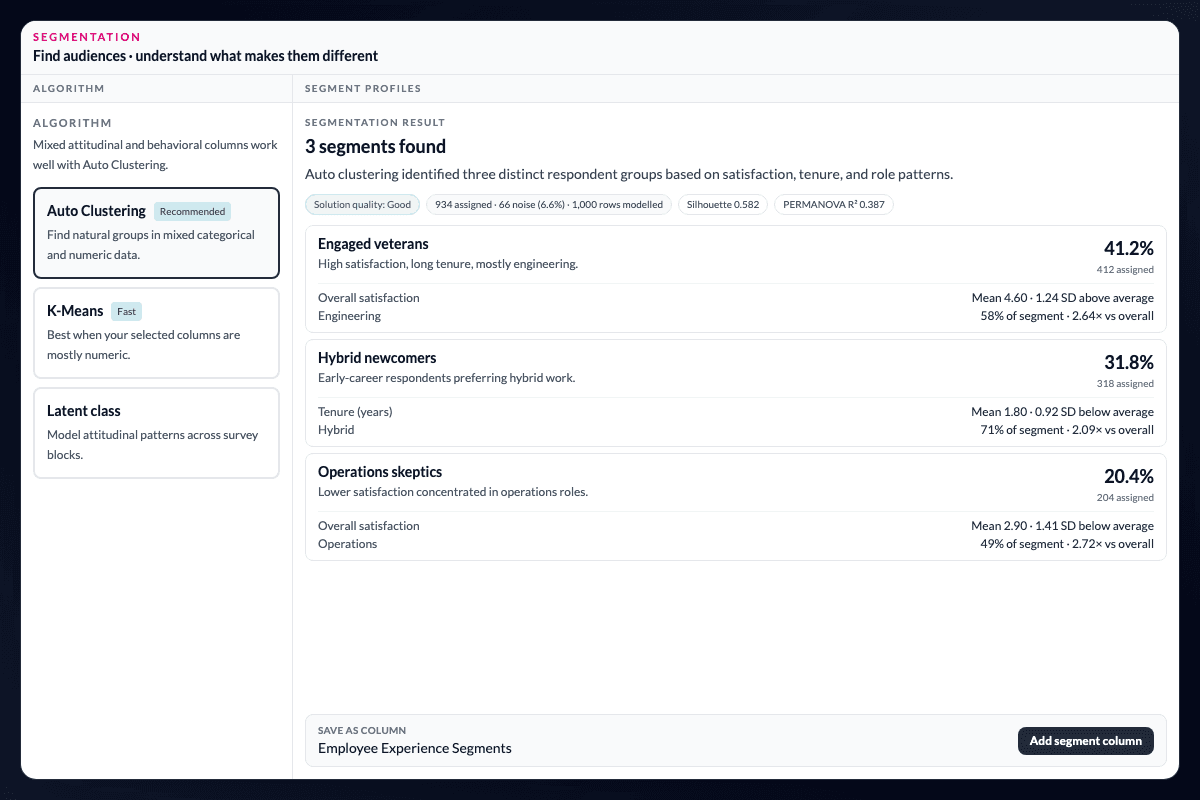
Which groups actually exist in this audience?
Segment respondents with an approach suited to numeric, categorical, or mixed survey data:
- Auto Clustering — finds natural groupings in mixed data and can mark outliers as Noise.
- Balanced Clusters — mixed data with more even segment sizes; choose 2–8 clusters.
- K-Means — distance-based groups on numeric profiles and opinion scales.
- K-Medoids — mixed survey variables with a fixed cluster count; robust centres are real respondents.
- HDBSCAN and Balanced HDBSCAN — density-based groups with noise detection, with the latter producing a more even allocation.
- Latent Class Analysis (LCA) — probabilistic segments from categorical, ordinal, boolean, and multi-select indicators.
Choose a solution you can defend.
Select columns, tune the settings or accept recommended defaults, then review separation with Silhouette score, PERMANOVA, and Cluster Quality. LCA compares class counts with AIC, BIC, and entropy, while session history makes it possible to compare configurations before saving a result.
Make the groups intelligible.
Each run shows the features that distinguish a cluster: numeric z-scores against the overall mean and categorical lift. Save the cluster labels as a project column, then profile the groups in tables, charts, filters, and delivery outputs instead of rebuilding them in another tool.
The algorithm is only the beginning of the segmentation.
A usable solution needs more than a set of labels. Researchers need to understand the variables that distinguish each group, inspect whether the segments are large and coherent enough for the study, and decide how they will be used in the wider project. AddMaple keeps that assessment beside the saved segment column, the tables, and the outputs that follow.
Questions teams ask
Which segmentation methods are available in AddMaple?
AddMaple supports Auto Clustering, Balanced Clusters, K-Means, K-Medoids, HDBSCAN, Balanced HDBSCAN, and Latent Class Analysis for suitable survey data.
How do I choose between segmentation methods?
Choose based on the variable types, whether you need a fixed number of groups, how you want to treat noise or outliers, and the quality measures relevant to the solution.
How can I tell whether a segmentation is useful?
AddMaple provides separation and quality measures including Silhouette score, PERMANOVA, Cluster Quality, and for LCA, AIC, BIC, and entropy.
Read the evidence in context
Results depend on the study design, data quality, bases, weighting, and method settings. AddMaple calculates the statistical outputs; researchers review practical importance and interpretation. An association is not evidence of causation.
How it works
Step-by-step guides in the AddMaple help center.
- Segmentation & clustering
Start here — when to segment, how to evaluate quality, and where saved cluster columns go next.
- Choosing a segmentation method
Pick K-Means, K-Medoids, HDBSCAN, Balanced HDBSCAN, or LCA with a practical decision table for mixed survey data.
- Latent Class Analysis
Model latent segments from categorical and multi-select batteries — compare class counts with BIC and entropy, then save a segment column.
- Run a segmentation
Step-by-step in Create Clusters — select columns, configure the algorithm, review profiles, and save a cluster column.
Part of AddMaple's feature areas
This capability sits within broader product areas on the features hub.
- Segmentation & advanced analysis
Continue exploring
Follow the next step in the workflow or explore a related capability.
- Segment profiling & comparisonProfile who each segment is and what differentiates them — ranked features, lift vs overall, and comparison views for banners, charts, and presentations.
- Advanced research methodsSpecialist research methods for preference and portfolio decisions — MaxDiff for item importance, TURF for reach and optimal combinations, and Conjoint for attribute trade-offs and scenario simulation — connected to the same tables, charts, and narrative as the rest of the study.
See this capability on a real research workflow.
Bring one study or delivery workflow and we’ll show where AddMaple fits.