


Discover
Open ends, transcripts & qualitative coding
AI-assisted coding into themes and optional topic-sentiment, with evidence paths back to underlying verbatims.
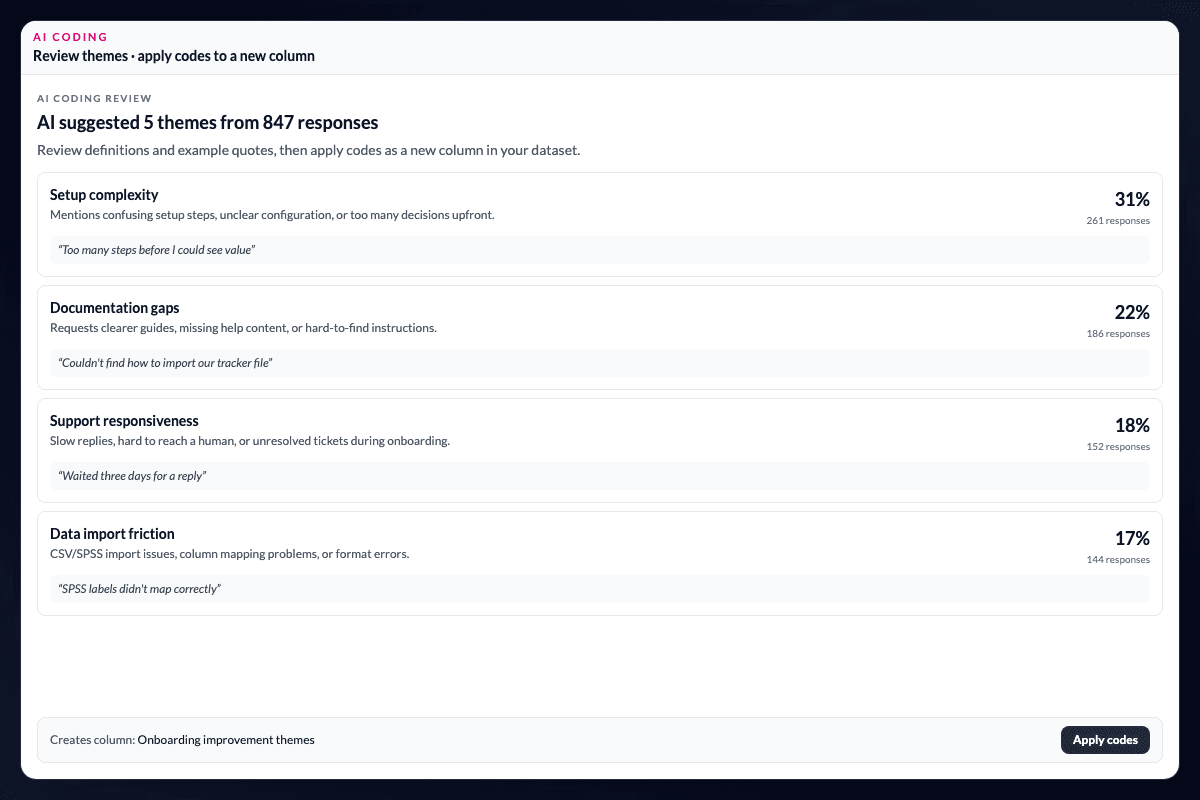
Code open ends without losing rigour.
Code open ends, interviews, and transcripts into themes, then review the assignments before using them in the wider research workflow. Start from your own codebook or ask AI to propose one with custom instructions; generated codes include descriptions and verbatim examples you can edit before applying.
Keep the researcher in control of the codebook.
The core loop is Code → review → trace to verbatims. Review individual records, correct mis-codes, merge or split themes, and re-apply the codebook across the dataset. Optional topic-sentiment adds polarity at the theme level.
Keep every theme connected to what people said.
Every theme remains linked to the source phrases that support it. The reviewed themes can then become variables for quantitative analysis, preserving an evidence path from codebook to verbatim rather than treating AI coding as a black box.
Scale the repetitive part without outsourcing the judgement.
Manual coding gives researchers control but becomes difficult to sustain across large or recurring text volumes. Blind automation is faster but leaves the codebook and its decisions hard to review. AddMaple puts the researcher between those extremes: AI accelerates application across the dataset, while the team decides what a theme means, which records belong to it, and whether the evidence supports the interpretation.
Questions teams ask
Can researchers control the coding approach?
Yes. Researchers can start with their own codebook or ask AI to propose one, edit descriptions and examples, correct individual assignments, and merge or split themes.
Can I trace a theme back to the original response?
Yes. Every theme remains linked to the source phrases and verbatims that support it.
What happens after open ends are coded?
Reviewed themes can become project variables for cross-tabs, significance testing, and linked quantitative and qualitative analysis.
Read the evidence in context
Results depend on the study design, data quality, bases, weighting, and method settings. AddMaple calculates the statistical outputs; researchers review practical importance and interpretation. An association is not evidence of causation.
How it works
Step-by-step guides in the AddMaple help center.
- AI thematic coding
Analyze open ends and transcripts into themes or categories with AI, review the codebook, and trace every coded theme back to source verbatims.
Part of AddMaple's feature areas
This capability sits within broader product areas on the features hub.
- Text & qualitative analysis
Continue exploring
Follow the next step in the workflow or explore a related capability.
- Turn qualitative themes into quantitative evidenceCode open ends and transcripts into themes, inspect verbatims, convert themes to variables, and cross-tab and test them against quant — in one loop.
- Quant & qual linked analysisConnect coded open ends and structured survey data in one inspectable workspace — not separate stories.
See this capability on a real research workflow.
Bring one study or delivery workflow and we’ll show where AddMaple fits.