


Discover
PCA & dimension reduction
What underlying dimensions sit behind this battery? Explore latent structure with PCA, loadings, variance explained, and optional Varimax rotation.
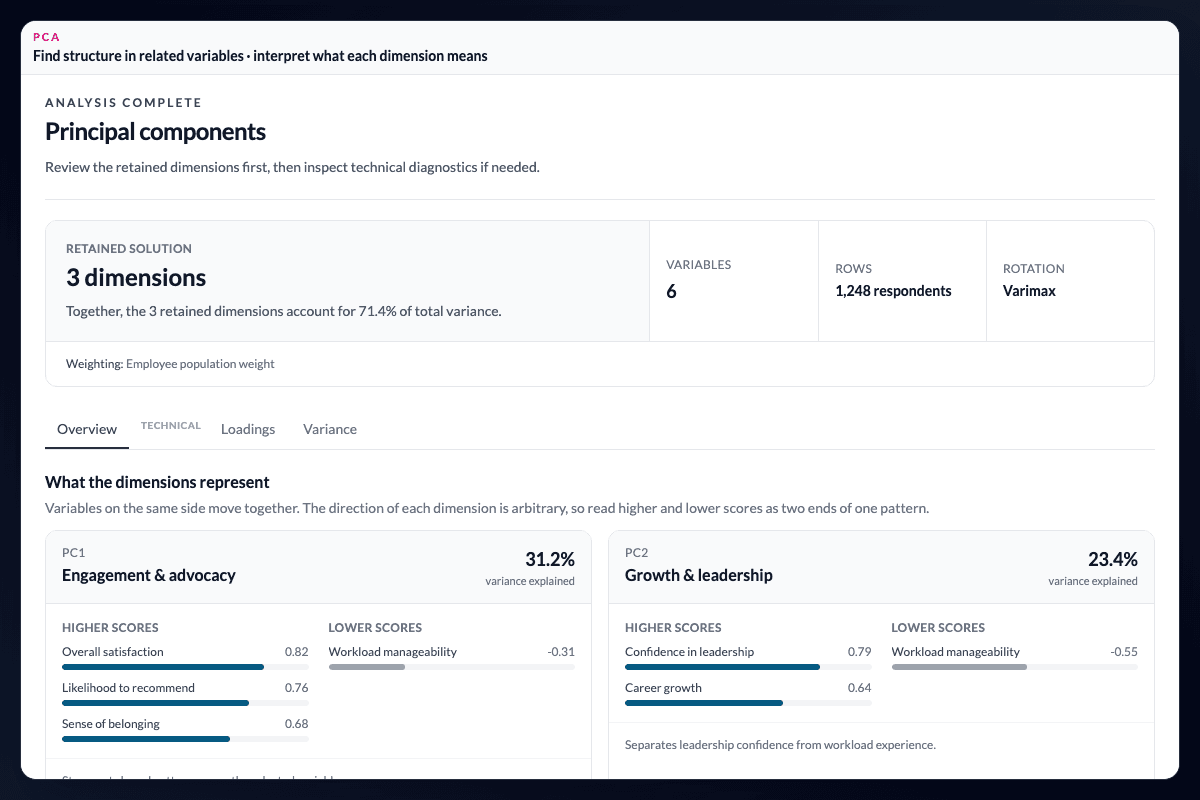
What underlying dimensions sit behind this battery?
Run principal component analysis on numeric and opinion-scale columns to explore latent structure and reduce dimensionality beyond one-at-a-time crosstabs and banners. AddMaple extracts components that capture the greatest variance across the battery.
See which questions belong together.
Review component loadings to interpret what each dimension represents and identify the questions that cluster together. Optional Varimax rotation can produce a simpler, more interpretable loading structure while keeping rotated components orthogonal.
Carry the structure into the wider study.
Use the components as inputs for segmentation or as a clearer way to tell the research story. The result stays beside the banners and charts it helps explain, rather than becoming an export from a separate factor-analysis workflow.
Use PCA as a way to organise evidence.
PCA does not decide what a construct means or prove that a dimension causes an outcome. It gives the researcher a compact view of co-movement in a battery, which can then be checked against the questionnaire wording, loadings, variance explained, and the purpose of the study before being used in a segment or narrative.
Questions teams ask
What is PCA useful for in survey research?
PCA helps explore underlying dimensions in a correlated numeric or opinion-scale battery and reduce many related measures into a smaller set of components.
What does AddMaple show for each component?
AddMaple shows component loadings, variance explained, and optional Varimax-rotated structure so researchers can interpret which questions belong together.
Can PCA components be used in later analysis?
Yes. Researchers can use the component structure to inform segmentation or storytelling while keeping the result alongside the project’s tables and charts.
Read the evidence in context
Results depend on the study design, data quality, bases, weighting, and method settings. AddMaple calculates the statistical outputs; researchers review practical importance and interpretation. An association is not evidence of causation.
How it works
Step-by-step guides in the AddMaple help center.
- PCA & dimension reduction
Run principal components on numeric and scale batteries — interpret loadings, variance explained, optional Varimax rotation, and component map.
Part of AddMaple's feature areas
This capability sits within broader product areas on the features hub.
- Segmentation & advanced analysis
Continue exploring
Follow the next step in the workflow or explore a related capability.
- Regression, PCA & multivariate modellingWhat is the estimated relationship — and what structure sits behind the batteries? Linear and logistic regression with fitted charts, Elastic Net multivariate key-driver models, and PCA with optional Varimax rotation.
- Segmentation & clusteringWhich groups actually exist in this audience? Compare clustering approaches suited to numeric, categorical, or mixed survey data, then profile the groups you can use.
- Advanced research methodsSpecialist research methods for preference and portfolio decisions — MaxDiff for item importance, TURF for reach and optimal combinations, and Conjoint for attribute trade-offs and scenario simulation — connected to the same tables, charts, and narrative as the rest of the study.
See this capability on a real research workflow.
Bring one study or delivery workflow and we’ll show where AddMaple fits.